
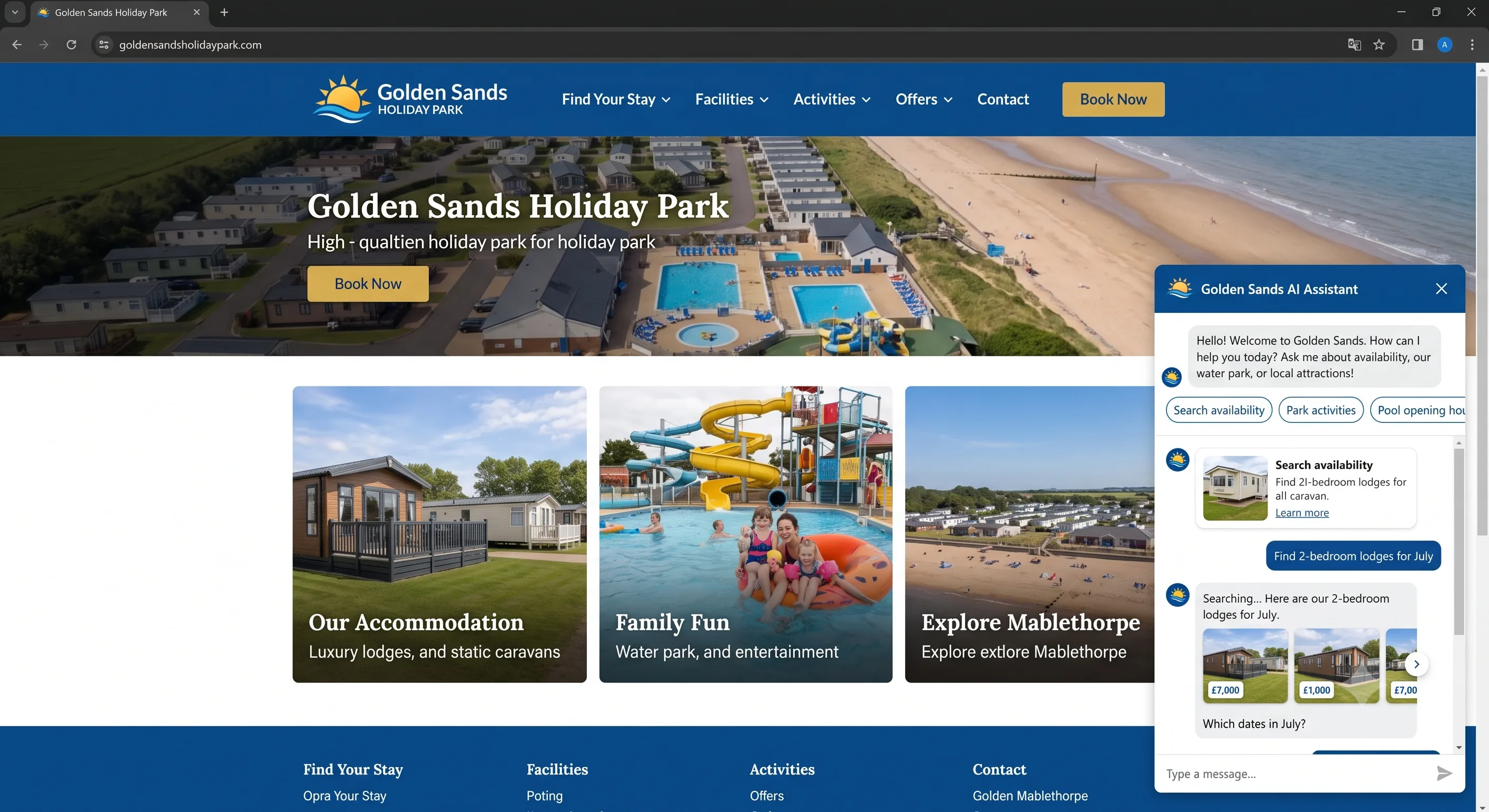
Why Every UK Holiday Park Website Needs an AI Assistant in 2026
Why Every UK Holiday Park Website Needs an AI Assistant in 2026
The widget your competitors haven't added yet — and why the ones that have are pulling ahead.
Your website is open 24 hours a day, seven days a week. Your team isn't.
That gap — between when guests want answers and when your staff are available to give them — is where bookings are lost, ownership enquiries go cold, and frustrated prospects quietly move on to the next park on their list.
An AI assistant widget changes that equation entirely. Not by replacing your team, but by ensuring that every visitor to your website — at any hour, on any device — gets an immediate, informed, helpful response.
This article explains what an AI website widget actually does, how it works in practice for a holiday park, and why the parks adding this capability now are building a genuine competitive advantage before the rest of the market catches up.
What Is an AI Website Widget?
An AI assistant widget is a chat interface embedded directly into your website — typically appearing as a small icon in the corner of the screen that expands into a conversation window when a visitor clicks it.
Unlike a basic live chat tool that simply passes messages to a member of staff, an AI assistant actively responds to enquiries using natural language. It understands questions, provides accurate answers based on your park's specific information, and guides visitors toward the next logical step — whether that's booking a break, requesting a brochure, or scheduling a call with your sales team.
The key distinction from the chatbots of five years ago is intelligence. Early chatbots followed rigid decision trees: press 1 for availability, press 2 for pricing. Modern AI assistants hold genuine conversations. They understand context, handle follow-up questions, and adapt their responses based on what a visitor actually says — not just the keywords they happen to use.
For a holiday park, this means a visitor can type "we're looking for something pet-friendly in August, preferably with a pool, for two adults and a teenager" and receive a helpful, specific response — not a generic menu of options.
What Can an AI Widget Actually Do for a Holiday Park?
The honest answer is: quite a lot. Here's where the capability sits in practice.
Answering Availability and Booking Enquiries
The most immediate use case is also the most impactful. Availability questions are among the highest-volume enquiries any holiday park receives, and they arrive at all hours — evenings, weekends, bank holidays.
An AI assistant integrated with your booking system can check live availability, explain pricing for specific dates, outline what's included in different accommodation types, and guide interested visitors directly to the booking process. Enquiries that would previously have sat unanswered overnight are resolved in seconds.
Integrating with your park management system (PMS) via its API means real-time data — not static information that goes out of date the moment a pitch is taken.
Qualifying Holiday Home Ownership Enquiries
Ownership enquiries are among the highest-value interactions your website generates, but they're also among the most unevenly handled. Many parks treat them the same as booking enquiries — a request goes in, someone responds when they can, and the follow-up depends on whoever picks it up.
An AI assistant changes this fundamentally. When a visitor expresses interest in holiday home ownership, the assistant can open a structured conversation: understanding their budget, preferred accommodation type, intended usage, and timeline. By the time that conversation reaches your sales team, it arrives with qualification data already gathered — not a cold lead requiring a discovery call from scratch.
For prospects browsing at 10pm after seeing your park on social media, this means their interest is captured and qualified immediately, rather than waiting until the next working day when their enthusiasm may have cooled.
Handling Pre-Arrival Guest Queries
Existing guests generate a steady flow of pre-arrival questions: check-in times, directions, what to bring, on-site facilities, local attractions, pet policies, accessibility information. These questions are entirely predictable, and answering them consumes a meaningful amount of reception and guest services time.
An AI assistant handles all of them instantly. Guests get the information they need. Your team's time is freed for the interactions that genuinely require a human touch.
Supporting Existing Holiday Home Owners
For parks with a holiday home ownership portfolio, the assistant isn't just a guest-facing tool. Existing owners have their own recurring needs: maintenance requests, annual service bookings, site fee queries, compliance documentation, event information.
An AI assistant provides a consistent, always-available point of contact for owner queries — capturing maintenance requests, answering common questions, and escalating anything that requires direct staff involvement. This improves owner satisfaction whilst reducing the administrative load on your aftersales team.
Capturing and Routing Enquiries Out of Hours
Perhaps the most straightforward commercial benefit: no enquiry goes unanswered.
When a prospect visits your website at 11pm and has a question, they have three options if no AI assistant is present. They can fill in a contact form and hope someone responds promptly. They can leave and try a competitor. Or they can abandon the enquiry entirely.
With an AI assistant, a fourth option exists: they get an immediate, helpful response, their question is answered, and — if they're ready — they're guided directly to the next step.
Research consistently shows that response speed is one of the strongest predictors of conversion for both accommodation bookings and holiday home sales. An AI widget means your park is always the first to respond, regardless of when the enquiry arrives.
How Does It Work in Practice?
Understanding the capability is one thing. Understanding how it actually works day-to-day is another.
Setup and Knowledge Base
An AI assistant for your holiday park is configured with your specific information — accommodation types, pricing ranges, availability rules, facilities, policies, ownership options, local area details, and frequently asked questions. This is the knowledge base that powers its responses.
This isn't a generic chatbot with placeholder content. It's an assistant that knows the difference between your touring pitches and your premium lodge plots, understands your seasonal pricing structure, and can accurately describe what's included in each accommodation tier.
The setup process involves working through your park's existing information and configuring the assistant accordingly — typically over a period of one to four weeks depending on the complexity of your operation.
Escalation and Human Handover
A well-configured AI assistant knows the limits of what it should handle independently. Financial transactions, complaints, complex legal queries, and situations requiring genuine human judgement are escalated to your team — with a full record of the conversation already in place, so staff can pick up without asking the visitor to repeat themselves.
This escalation capability is important for the parks that are rightly cautious about automation. The AI handles the volume. The humans handle the complexity. The two work together, not in competition.
Integration With Your Existing Systems
The practical value of an AI widget increases significantly when it's integrated with your park management system (PMS), CRM, and booking systems. Integration means the assistant is working from live data — real availability, accurate pricing, up-to-date owner records — rather than static information that requires constant manual updating.
For any UK holiday park, a working integration with your park management system and CRM is the difference between an assistant that can genuinely answer booking questions and one that can only say "please call us to check availability" — which rather defeats the purpose.
Channels Beyond the Website
An AI assistant capability doesn't have to live exclusively on your website. The same intelligence can be deployed across WhatsApp, Facebook Messenger, SMS, and email — meeting guests and prospects on the channels they actually use, rather than requiring them to visit your website to get a response.
For many parks, WhatsApp in particular has become a preferred communication channel for guests. An AI assistant that responds intelligently via WhatsApp extends your responsiveness to where the conversations are already happening.
The Commercial Case
The practical benefits translate into measurable commercial outcomes. Here's where the numbers matter.
Response speed and booking conversion. A Harvard Business Review study of online sales leads found that businesses replying within an hour were nearly seven times as likely to qualify the lead as those that waited even an hour longer. An AI assistant means your park replies straight away, at any hour.
Out-of-hours enquiry capture. ParkPilot estimates that around 42% of holiday park enquiries arrive outside standard business hours. Without an AI assistant, a significant proportion of these either go unanswered until the next working day or are lost entirely.
Staff time reallocation. Routine enquiries — availability checks, FAQ responses, pre-arrival information — account for a substantial proportion of guest services workload. Handling these automatically frees your team for the interactions that require genuine hospitality skills and human judgement.
Ownership lead quality. AI-assisted qualification means ownership leads arriving at your sales team are pre-screened for budget, timeline, and fit — improving sales appointment efficiency and overall conversion rate.
What to Look for When Choosing an AI Widget for Your Park
Not all AI assistant solutions are built equally, and for a holiday park the wrong choice can create more problems than it solves. Here's what matters.
Domain knowledge. A generic AI chatbot trained on broad internet data won't understand the specific language and structure of holiday park operations. You need an assistant configured specifically for the industry — one that understands the difference between a holiday home and a touring pitch, knows what site fees are, and doesn't confuse a lodge owner with a guest.
Integration capability. The value of an AI assistant is significantly reduced if it can't connect to your PMS and CRM. Ensure any solution you evaluate has genuine integration capability with the systems you already use, and can both read and write data — not just pull static information.
Human oversight and control. The parks most comfortable adopting AI are the ones that feel genuinely in control of what it does and doesn't handle. Look for solutions that allow clear configuration of escalation rules, provide full audit trails of every conversation, and give your team the ability to adjust what the assistant manages.
GDPR compliance. Your AI assistant is processing personal data about your guests and prospects. UK GDPR compliance isn't optional, and it should be designed into the solution from the outset — not bolted on as an afterthought. Ask any provider directly about data storage, processing locations, and their approach to data minimisation.
Honest performance expectations. Be cautious of any provider promising dramatic results without context. An AI assistant improves response times, captures more enquiries, and handles routine queries efficiently. The commercial impact is real and measurable. But it works best as part of a broader digital strategy — not as a standalone solution to every operational challenge.
You can also compare ParkPilot AI pricing plans or explore ParkPilot CRM for holiday home sales.
The Competitive Window
Here is what makes this moment significant for UK holiday parks specifically.
The majority of parks in the UK do not yet have an AI assistant on their website. Most are still relying on contact forms, phone lines, and staff availability to handle online enquiries. The parks that adopt this capability now — and configure it properly — are establishing a genuine responsiveness advantage before the rest of the market does the same.
That advantage is most acute in the out-of-hours window. A prospect comparing three parks on a Saturday evening is highly likely to book with the park that responds immediately and helpfully, rather than waiting until Monday morning to hear from the other two.
The window for easy competitive advantage will not remain open indefinitely. As AI assistants become standard across the sector, the differentiation will shift from having one to having a better-configured, better-integrated one. But right now, simply having a capable AI assistant puts a park meaningfully ahead of most of its competitors.
Getting Started
The first step is straightforward: understand what your current website is — and isn't — doing for the guests and prospects who visit it.
How many enquiries arrive outside business hours? How long does the average response take? What are the most common questions your team answers repeatedly? What happens to an ownership prospect who visits your site at 9pm on a Sunday?
If the honest answer to any of these questions gives you pause, an AI assistant is worth a serious look.
ParkPilot AI builds AI assistants purpose-built for UK holiday parks — working alongside the park management systems and CRMs parks already use via standard APIs, configured with genuine domain knowledge, and designed to handle guest services, ownership enquiries, owner support, and admin queries around the clock.
If you want to see how this would work for your park, the next step is a free, no-obligation trial, set up around your enquiry patterns, systems and operational priorities.
About the Author
Ryan Metcalfe is the founder of ParkPilot AI, with over 11 years of experience in UK holiday park operations and sales. He built ParkPilot specifically to solve the operational challenges he encountered first-hand — starting with the enquiries that arrive when nobody's there to answer them.